If you’ve spent any time online lately, you’ve probably noticed something: ads feel more relevant, chatbots respond faster, and websites seem to “know” what you want before you ask. That’s not a coincidence. It’s AI in digital marketing at work.
AI has moved from being an experimental tool to a core part of how brands plan, create, and optimize their marketing. But what does that actually mean for your business, and how do you use it without losing the human touch your customers still expect?
This guide breaks it all down in plain language — what AI in digital marketing really is, how it works, where it delivers the most value, and how to avoid the common mistakes businesses make when adopting it.
What is AI in Digital Marketing?
AI (Artificial intelligence) in digital marketing refers to the use of machine learning, natural language processing, and data analytics to plan, automate, and improve marketing activities. Instead of relying purely on guesswork or manual analysis, marketers use AI to process large amounts of customer data and act on it in real time.
In simple terms, AI helps marketing teams:
- Understand customer behavior faster
- Personalize content and offers at scale
- Automate repetitive tasks
- Predict what’s likely to happen next
- Measure results more accurately
It’s not about replacing marketers. It’s about giving them better tools to make faster, smarter decisions.
Why AI Matters in Marketing Right Now
Search and shopping behavior are changing rapidly. Third-party cookies have been phased out, meaning brands can no longer track users across the web in the same way without their consent. At the same time, AI agents and AI-powered browsers are increasingly acting on behalf of users by researching products, comparing options, and even completing tasks such as bookings.
This shift means two things for marketers:
- First-party data and permission-based personalization matter more than ever.
- Content needs to be understandable by both people and AI systems – which is exactly why Answer Engine Optimization (AEO) and Generative Engine Optimization (GEO) have become part of everyday SEO strategy.
The shift is also visible in search itself: AI-powered search now favors structured, authoritative content over simple keyword density, so businesses that used to rely on basic SEO tactics need a more thoughtful, intent-driven approach.
Key Benefits of Using AI in Digital Marketing
1. Hyper-Personalization at Scale
AI can analyze browsing history, purchase patterns, and on-site behavior to tailor content, product recommendations, and offers to each visitor — without a human manually adjusting every campaign.
2. Faster, Smarter Customer Support
AI-driven chatbots and virtual assistants can answer common questions instantly, qualify leads, and hand off complex issues to a human agent when needed. This keeps customers engaged around the clock.
3. Predictive Analytics
Rather than reviewing performance after a campaign ends, AI tools can forecast likely outcomes and flag risks early, helping teams adjust budgets and strategy before results suffer.
4. Content and SEO Efficiency
AI tools can help identify keyword opportunities, content gaps, and search intent patterns much faster than manual research, freeing up time for strategy and creativity.
5. Better Ad Targeting and Spend Efficiency
Machine learning models continuously test and adjust ad targeting, bidding, and creative variations, helping reduce wasted spend and improve return on investment.
How AI Is Actually Used in Digital Marketing (Real Examples)
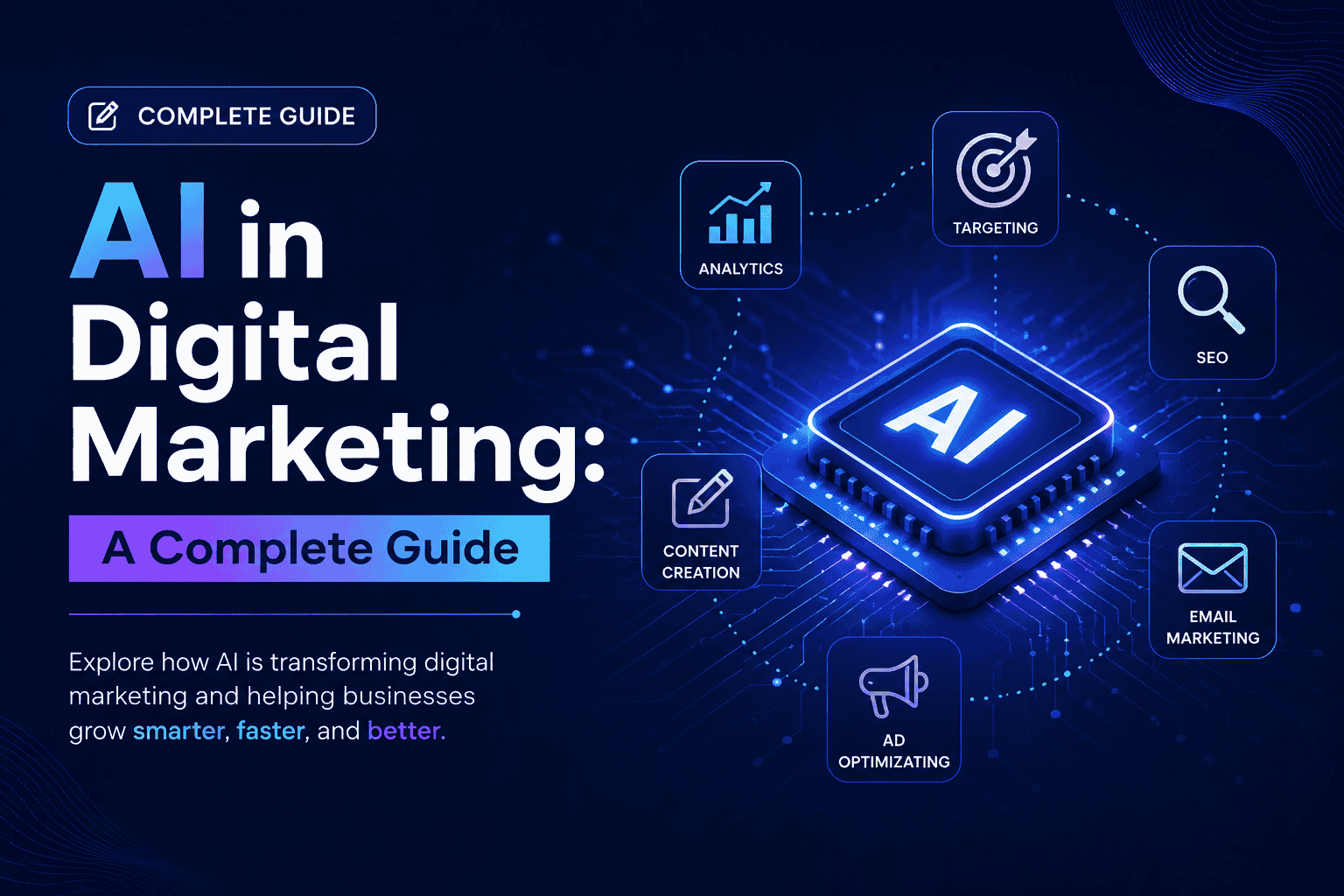
| Marketing Function | How AI Helps |
| Content creation | Drafting first versions of blogs, product descriptions, and ad copy for human review |
| Customer service | AI chatbots handling FAQs, order tracking, and appointment scheduling |
| Email marketing | Sending personalized subject lines and send-times based on user behavior |
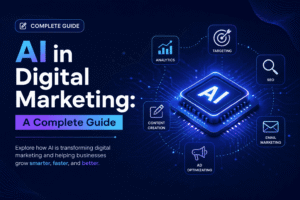
| SEO | Identifying search intent, content gaps, and structuring content for AI-driven search results |
| Paid ads | Automating bid adjustments and audience targeting in real time |
| Analytics | Surfacing patterns in customer data that would take humans much longer to find |
A Simple AI Marketing Workflow
- Collect data — website behavior, CRM data, past campaign performance (with proper consent).
- Choose the right AI tools — for content, chat, analytics, or ads, depending on your goals.
- Set clear guardrails — brand voice, accuracy checks, and human review points.
- Launch and monitor — let AI handle repetitive optimization while your team tracks the bigger picture.
- Review and refine — use AI-generated insights to improve future campaigns.
This is where working with an experienced online marketing agency can help – someone who already understands which tools fit your industry and how to avoid the trial-and-error phase.
Best Practices for Using AI in Digital Marketing
- Keep a human in the loop. AI should support your team’s expertise—not replace it. The best results come when marketers use AI as a creative partner to brainstorm ideas, speed up workflows, and improve efficiency, while relying on human judgment to shape strategy, maintain brand voice, and ensure content quality.
- Prioritize first-party data. With cookies phased out, building direct relationships with your audience matters more than ever.
- Fact-check AI output. AI tools can be confidently wrong. Always verify claims before publishing.
- Optimize for people first, algorithms second. Content that genuinely helps readers tends to perform better across both traditional search and AI-driven search.
- Start small. Pilot AI in one area — like customer support or email personalization — before scaling across your whole marketing stack.
Common Mistakes to Avoid
- Over-automating customer interactions, leading to generic, impersonal experiences.
- Publishing AI-generated content without review, risking factual errors or off-brand messaging.
- Ignoring data privacy requirements when collecting and using customer data.
- Chasing every new AI tool instead of focusing on the ones that solve a real business problem.
- Treating AI as a one-time setup rather than something that needs ongoing monitoring and adjustment.
AI-Powered Chatbots: A Practical Starting Point
If you’re new to AI in marketing, chatbots and marketing automation are often the easiest place to start. They provide immediate, measurable value — faster response times, more captured leads, and lower support costs — without requiring a complete overhaul of your marketing strategy. This is exactly the kind of work our team specializes in, and it’s often paired with affordable digital marketing services so smaller businesses can adopt AI without a large upfront investment.
Conclusion
Artificial intelligence in digital marketing isn’t a trend to wait out — it’s becoming the standard way brands understand customers, personalize experiences, and make marketing decisions. The businesses that benefit most are the ones that use AI to support their team’s judgment, not replace it, while staying focused on genuinely helpful, trustworthy content.
If you’re ready to bring AI into your marketing strategy — from chatbots to full campaign automation — our team can help you build a plan that fits your business and budget.
Ready to get started? Contact us today to see how AI-powered marketing and automation can work for you.
Frequently Asked Questions
1. What is artificial intelligence in digital marketing?
It’s the use of AI technologies — like machine learning and natural language processing — to automate, personalize, and optimize marketing activities such as content creation, advertising, customer support, and SEO.
2. Is AI replacing digital marketers?
No. AI handles repetitive, data-heavy tasks, but strategy, creativity, and brand judgment still require human oversight. Most successful teams use AI as a support tool, not a replacement.
3. How do AI chatbots help with marketing?
AI chatbots respond to customer questions instantly, qualify leads, and free up your team to focus on more complex interactions — improving both response time and customer satisfaction.
4. Is AI marketing affordable for small businesses?
Yes. Many AI tools and services are scalable, so small businesses can start with a single use case, like chatbot support or email personalization, before expanding.
5. What’s the difference between AEO, GEO, and traditional SEO?
Traditional SEO focuses on ranking in search engine results pages. AEO (Answer Engine Optimization) focuses on providing direct answers for voice and AI assistants. GEO (Generative Engine Optimization) focuses on structuring content so AI tools can understand and cite it accurately. All three now work together in a modern content strategy.